ADHD and Cleaning: Why the Dishes Feel Impossible (and How to Start)
The dishes have been in the sink for four days. It's not laziness. Cleaning is uniquely hard for ADHD brains, and here's why, plus 7 strategies that actually get you moving.
The dishes have been in the sink for four days. You walk past them every hour. You feel the guilt every time. And still, you can't seem to just... do them.
There's a specific kind of shame that comes with a messy home when you have ADHD.
It's not that you don't see the mess. You see it constantly. The pile of clean laundry on the chair. The doom pile on the desk. The three glasses on the nightstand. You know exactly what needs to happen. You've known for days. And somehow the knowing makes it worse, because now there's a running voice asking why a functional adult can't manage something as basic as washing a plate.
If this is you, please hear this first: you are not lazy, and you are not a slob. Cleaning is genuinely, neurologically harder for your brain than it is for most people. Once you understand why, you can stop fighting your brain and start working with it.
Why Cleaning Is So Hard for ADHD Brains
Chores look simple from the outside, which is exactly why the struggle feels so shameful. But "clean the kitchen" is not one task. It's a stack of executive-function demands your brain has to run all at once.
It's boring, and your brain is starved for dopamine
The ADHD brain runs low on dopamine, the chemical that drives motivation and reward. Understimulating tasks like wiping a counter offer almost no dopamine hit, so your brain treats them as nearly impossible to start. It's not a character flaw. Your brain is literally not getting the fuel it needs to initiate.
"Clean the room" is invisible and enormous
Neurotypical brains break "clean the room" into steps automatically. The ADHD brain often sees one giant, undefined blob of a task with no obvious first move. That blob triggers overwhelm, and overwhelm triggers the freeze. This is task initiation failure, and it's a hallmark of ADHD paralysis.
Out of sight, out of mind (object permanence)
Many ADHD adults rely on visual reminders. If you put something away in a drawer, it effectively stops existing. So you leave things out to remember them, and "out" slowly becomes clutter. The mess is often a survival strategy that quietly turned against you.
Doom piles and the "I'll deal with it later" trap
A doom pile ("Didn't Organize, Only Moved") is what happens when deciding where each item goes is too many micro-decisions, so everything gets swept into one spot instead. Each object is a tiny choice, and decision fatigue stacks up fast.
Perfectionism and all-or-nothing thinking
If you can't clean the whole apartment perfectly, why start at all? This all-or-nothing wiring means a task isn't worth beginning unless it can be finished completely, so it never begins.
7 ADHD-Friendly Strategies to Actually Get Cleaning Done
The goal isn't to become a naturally tidy person. It's to build enough structure and stimulation that starting becomes possible. Here are seven approaches that work with the ADHD brain.
1. Shrink the task until it's almost silly
"Clean the kitchen" is a trap. "Put one glass in the dishwasher" is a doorway. The rule: make the first step so small that saying no feels ridiculous. Momentum does the rest, because starting is the hard part, not continuing.
- How Dopamind helps: Facing a chore that feels like a mountain? Hit the AI Breakdown button. Type "clean the kitchen" and Dopamind turns it into bite-sized steps: clear the sink, load the dishwasher, wipe the counter, take out the trash. You only ever have to look at step one.
2. Brain-dump the mess out of your head
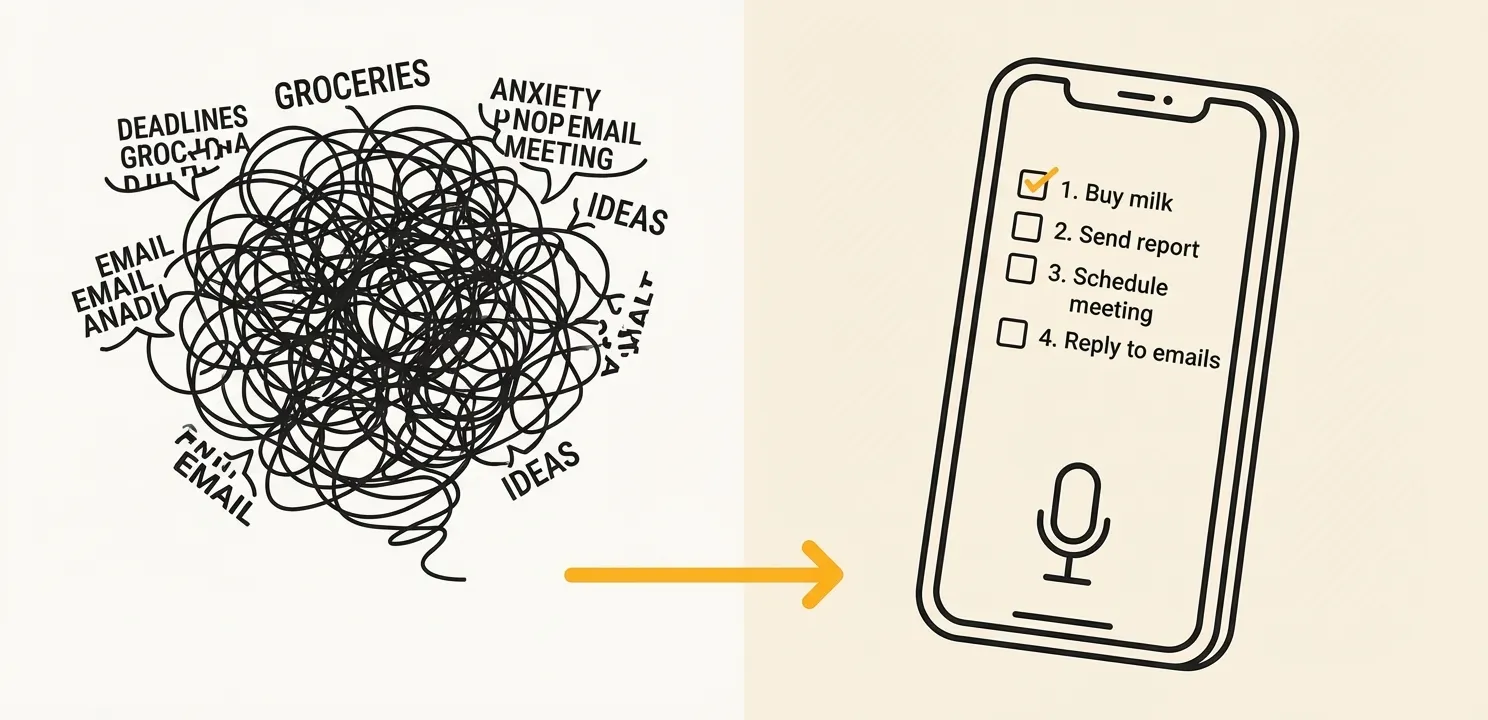
When your whole home feels chaotic, your working memory is overloaded before you lift a finger. Get it out of your head and onto a list so your brain can stop juggling it.
- How Dopamind helps: Don't type it out, just talk. Use Voice Input and ramble: "the kitchen's a disaster, laundry's everywhere, and I keep forgetting to take the bins out." Dopamind listens and sorts the chaos into a clear checklist automatically.
3. Set a timer and race the clock
Boring tasks become tolerable when you add urgency and a clear finish line. A 10-minute timer turns an open-ended chore into a short, winnable sprint. You are not cleaning the house. You are cleaning for 10 minutes, then you stop.
- How Dopamind helps: Start a Focus session for a single chore. The countdown adds the gentle pressure ADHD brains respond to, and when time's up, you're genuinely done.
4. Use body doubling so you're not alone
"Body doubling" means doing a task alongside another person. Their presence anchors your attention and makes starting far easier. It's one of the most reliable ADHD tools there is.
- How Dopamind helps: Think of the AI as your digital body double. It's always there, checking in during a session and cheering you on, so cleaning stops feeling like a lonely, invisible battle.
5. Celebrate the win out loud
The ADHD brain needs the reward now, not someday. Naming a finished chore and getting immediate acknowledgment gives you the dopamine hit that makes you want to do it again.
- How Dopamind helps: After a focus session, tell the AI what you did ("I finally did four days of dishes"). It responds with real, personalized encouragement, closing the loop your brain has been missing.
6. Fight object permanence with visible systems
Since "away" means "gone" for your brain, lean into visibility instead of fighting it. Clear bins, open shelves, and a single visible daily list beat tucking things into drawers you'll never open.
- How Dopamind helps: Recurring chores live on your Calendar as concrete, visible blocks, so "clean the bathroom" exists outside your head where you can actually see it coming.
7. Redefine "done" as "better than before"
Perfectionism is procrastination in disguise. A half-cleared counter is a win. Dishes done but the floor unswept is a win. Progress beats a spotless home you never start on.
The ADHD Tax Nobody Talks About
Cleaning struggles come with hidden costs: the takeout because the kitchen's unusable, the second phone charger because you can't find the first, the late fee on a bill buried in a doom pile. This is the ADHD tax, and it compounds.
Part of "cleaning" is really life admin, and it deserves systems too. Dopamind's Life OS quietly handles the pieces that hide in the clutter: the Subscription Tracker flags renewals before they charge you, and the Fridge Manager tells you what to eat before it spoils. Fewer things rotting in the fridge means fewer chores, and less shame, later.
FAQ: ADHD and Cleaning
Why can't I clean even when I really want to?
Wanting to isn't the bottleneck. Cleaning requires task initiation, working memory, and sequencing, the exact executive functions ADHD affects. Low dopamine makes boring tasks feel physically impossible to start, no matter how much you want a clean home.
Is a messy house always a sign of ADHD?
No. Plenty of people are messy without ADHD, and plenty of ADHD adults keep tidy homes through effort and systems. But chronic difficulty with chores, despite genuinely caring, is a very common ADHD experience tied to executive dysfunction.
What's a "doom pile"?
A doom pile is a spot where miscellaneous items accumulate because deciding where each one goes is too many decisions at once. The name comes from "Didn't Organize, Only Moved." Breaking it into a few timed sessions, one small pile at a time, is the way through.
Does breaking tasks down really help?
Yes. Task initiation failure usually comes from a task feeling too big and undefined. Breaking it into concrete, tiny steps removes the overwhelm and gives your brain an obvious, low-stakes first move, which is often all it needs to start.
Related Reading
- ADHD Paralysis: 8 Ways to Break Free and Get Unstuck – When your brain hits the brakes and you can't start anything.
- Why Your Morning Routine Keeps Failing – It's not discipline, it's how your brain produces dopamine.
- How to Be Productive Working From Home – 12 tactics for easily distracted brains.
You Don't Need More Willpower. You Need Better Scaffolding.
The dishes in the sink were never a moral failing. They were a task your brain couldn't sequence, stimulate, or start on its own. That's not something you fix by trying harder. It's something you fix by building scaffolding around the parts your brain struggles with.
Dopamind is that scaffolding: an AI companion that breaks the overwhelming into the doable, keeps you company while you work, and celebrates the win when you're done.
Ready to make the impossible chore possible?
Dopamind breaks overwhelming tasks into steps your brain can actually start. Available now on the App Store.
Try Dopamind for Free